


Thermonuclear materials: tungsten walls and their service life in fusion reactors (2026)
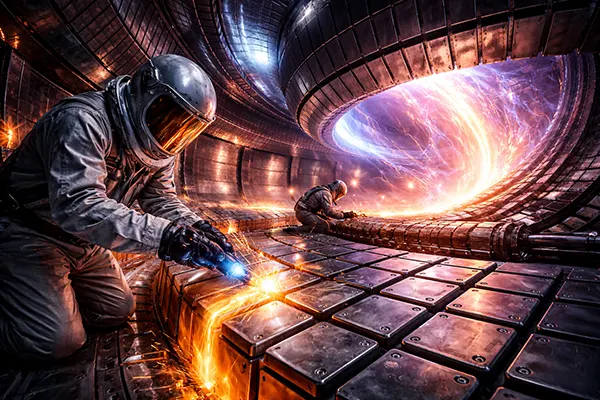
Tungsten sits at the sharp end of fusion engineering: it is the material that has to face a hot plasma, survive repeated thermal shocks, and stay attached to a cooled structure that removes megawatts per square metre. The reason it features so heavily in ITER and DEMO discussions is straightforward—few candidate materials combine an extremely high melting point with comparatively low erosion under fusion-relevant edge conditions. The harder truth is that “tungsten lifetime” is not a single number: it is a balance of erosion, cracking, microstructural change, melting margins, joining integrity, and how effectively a machine avoids the most damaging off-normal events.
Why tungsten is used, and what “lifetime” really means
Tungsten is selected primarily because it can tolerate very high surface temperatures and heat fluxes, especially in the divertor where exhaust power concentrates. In practical engineering terms, component life is not defined by a headline melting point; it is defined by a set of limits that protect performance and safety: maximum allowable surface temperature, acceptable crack density, permissible thickness loss, and the point where the thermal joint to the heat sink becomes unreliable.
Location matters as much as material choice. The “first wall” in the main chamber sees demanding conditions, but the harshest environment is typically the divertor strike zone, where peak steady heat flux and frequent thermal cycling can be severe. For this reason, long-term operation is often managed with an exposure budget: each high-power pulse, transient, and recovery cycle consumes part of the allowable damage margin.
Lifetime is also coupled to plasma purity. Tungsten is a high-Z element; if too much tungsten enters the core plasma, radiative losses rise and performance can degrade. That feedback pushes designs towards magnetic geometries and operational regimes that keep tungsten erosion low, limit prompt transport to the core, and maintain stable edge conditions that do not trigger runaway impurity release.
Core damage mechanisms engineers track on tungsten surfaces
Thermal fatigue is a dominant mechanism in cyclic operation. Repeated heating and cooling creates surface and near-surface stresses that can form a network of microcracks. Even when cracks remain shallow, they roughen the surface, change local heat absorption, and can concentrate loads at sharp features, making later damage more likely.
Recrystallisation is another milestone because it alters tungsten’s microstructure. As grains grow at elevated temperatures, the material can lose strength and become more susceptible to crack growth under repeated thermal loading. Engineers therefore aim to keep operating temperatures within a window that avoids brittle behaviour at low temperature and excessive softening or microstructural change at high temperature, acknowledging that the most exposed zones sit closer to limits.
Transient melting is the fastest route to shortened service life. Disruptions, strong edge events and other off-normal scenarios can push local surface temperature beyond the melting threshold, particularly at edges, gaps and castellations where power concentrates. Once melting occurs, the surface can deform and re-solidify in a weakened state, increasing the likelihood of future hotspots and accelerating the need for replacement.
Erosion and material migration: what experiments have taught us so far
Erosion of tungsten armour is frequently driven by sputtering: energetic particles and impurity ions knock tungsten atoms out of the surface. In reactor-relevant conditions, the story is often “mixed materials” rather than pure tungsten. Lighter species (for example, beryllium in ITER-like scenarios) can enhance tungsten erosion in specific divertor regimes, even when edge temperatures appear moderate.
Migration complicates any simple “millimetres per year” estimate. Tungsten that erodes from one location can redeposit elsewhere—sometimes close by, sometimes in cooler shadowed regions, and sometimes inside gaps. From a lifetime perspective, redeposition can reduce net thickness loss at a peak heat spot, but it can also build fragile layers, contaminate diagnostic lines-of-sight, and increase dust formation risks in places that are difficult to inspect.
Fuel retention is usually discussed most strongly for carbon-facing components, but tungsten systems still require careful accounting. Co-deposited layers containing other elements, plus trapping in damaged near-surface zones, can contribute to fuel inventory. That is why modern plasma–wall interaction work treats erosion, dust, redeposition and fuel retention as coupled phenomena rather than separate topics.
How long-pulse operation changes the erosion problem
Short pulses are often limited by transients; long pulses expose the slow burners: steady sputtering, gradual surface evolution, and cumulative fatigue in the bonded structure beneath the armour. Long-pulse campaigns are valuable because they reveal whether small, repeatable mechanisms accumulate into meaningful performance loss, even without a single dramatic event.
Long pulses also bring detachment control into focus. If a divertor can be held in a stable detached regime, surface heat loads and sputtering drivers can drop substantially. But detachment is not free: it requires reliable feedback control, careful impurity seeding, and robust diagnostics to avoid oscillations that repeatedly re-attach the divertor and impose damaging heat spikes.
From a component-life viewpoint, consistency matters. A slightly lower peak heat flux maintained for longer can still deliver a large total thermal dose, so engineers track not just peaks but also cumulative exposure, number of cycles, surface temperature margins, and how often operating points approach thresholds associated with cracking or microstructural change.
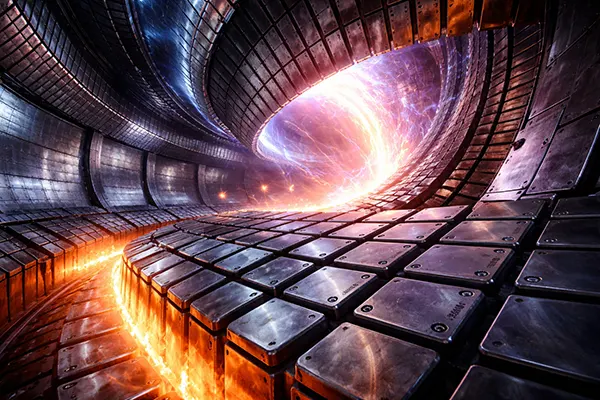
Design and operations strategies that extend tungsten wall service life
The most effective lifetime strategy is to prevent damage rather than rely on material strength alone. In practice that means increasing margins to melting and crack initiation by spreading heat loads, optimising magnetic strike-point positions, and avoiding sharp geometric features that concentrate power. Small design choices around edges, gaps and tile shaping can deliver outsized gains because those are common initiation points for hotspots and local failure.
Hardware design is a system, not a single material. Many divertor solutions use tungsten armour bonded to a copper-alloy heat sink with internal water cooling. In that layered structure, end-of-life can be driven by loss of thermal contact, fatigue in the joint, or degradation of cooling channels—even when the tungsten surface still appears serviceable. Qualification therefore focuses on repeated high-heat-flux cycling that tests both surface integrity and the stability of heat removal.
Operational control of transients often sets real-world lifetime. ELM pacing or suppression, disruption avoidance, and effective mitigation of runaway-electron scenarios directly reduce the probability of melt events and limit shock loading. Because off-normal events can consume a large fraction of lifetime margin in a single episode, modern operating envelopes are typically defined by constraints tied to transient families rather than by a single steady-state heat-flux number.
How engineers estimate replacement intervals in practice
Replacement planning usually starts with mapping and measurement: where are the highest heat loads, where do surface temperatures run closest to limits, and which regions show the strongest tungsten source signals? Teams then combine diagnostics (such as infrared thermography and spectroscopy) with modelling that converts operational history into cumulative damage indicators, enabling a ranked view of risk rather than a single “tile lifetime” figure.
Inspection strategy changes the effective lifetime of the machine. If the design allows targeted replacement of the most exposed sections, scheduled maintenance can keep availability high and reduce the need to operate conservatively. If access is difficult and replacement is slow, operators often impose stricter limits to avoid unplanned downtime—so maintainability and remote handling become part of the lifetime equation from the design stage.
As of 2026, the clearest takeaway is that tungsten wall lifetime is a systems problem. Material choice matters, but the most reliable improvements come from stable edge scenarios, detachment control, careful geometry, and joints and cooling structures that keep their performance after thousands of cycles. The best lifetime gains are achieved when wall conditions are measured honestly shot by shot, and operating regimes are adjusted early—before small degradations become replacement-driving failures.