


AI Companions in Physical Robots: Why Voice Models Are Moving from Smartphones into Home Machines
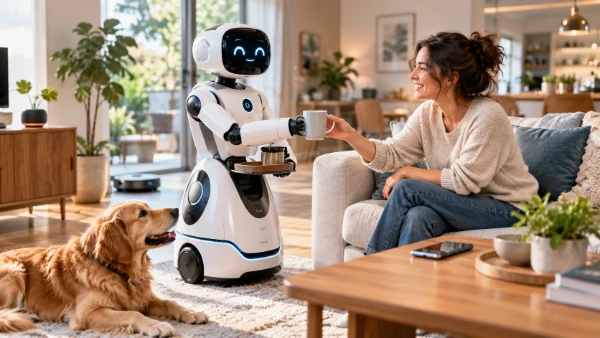
For years, talking to artificial intelligence meant looking at a phone, opening an app or speaking to a smart speaker sitting on a shelf. That boundary is beginning to disappear. By 2026, conversational AI is increasingly being connected to machines that can see a room, move through it and, in some cases, handle everyday objects. Products such as the 1X NEO home robot, Intuition Robotics’ ElliQ and LG’s CLOiD illustrate different stages of this transition. Some focus on companionship, others on household assistance, but they share an important idea: spoken AI becomes more useful when it understands not only a conversation but also the physical situation in which that conversation takes place.
Why Conversational AI Is Moving Beyond Phones and Smart Speakers
The smartphone was a natural first home for modern voice assistants because it already contained microphones, speakers, cameras, internet access and substantial computing power. Yet phones also impose a clear limitation. An AI assistant may explain how to sort laundry, prepare a simple meal or find a misplaced object, but the device itself cannot normally walk across the room, inspect the surroundings from different angles or interact with the object being discussed. Physical robots change that relationship by giving conversational AI a presence in the same environment as the user.
This development has become more practical because voice AI itself has changed. Earlier assistants were often built around relatively rigid command structures: play a song, set a timer, check the weather or switch on a connected light. Newer conversational models can interpret longer requests, maintain context and respond to follow-up questions without requiring users to repeat the entire command. In a robot, that makes speech useful for more than issuing instructions. A person can explain what they want in ordinary language, clarify the request midway through a task and refer naturally to objects or events in the room.
At the same time, robot developers are combining speech with cameras, movement sensors and spatial awareness. This matters because a useful home assistant must understand phrases such as “put that cup in the sink” or “bring me the book from the table” without requiring every object and location to be entered manually. The shift is therefore not simply about putting a chatbot inside a moving shell. The larger change is the combination of conversation with perception and physical action, allowing an AI system to connect words with what is actually happening around it.
From Voice Commands to Context-Aware Companions
Context is what separates a conventional voice interface from a more convincing AI companion. A phone may remember a previous chat, but a home robot can potentially combine conversational memory with information about where it is, what it can see and what the user is doing. The result can be a very different type of interaction. Instead of saying, “Set a reminder for my medication at 7 pm,” a person might ask a companion to remind them after dinner, with the system using the household routine and previous interaction to determine when the reminder is appropriate.
ElliQ provides an established example of how this concept can work without requiring a humanoid body. Developed by Intuition Robotics primarily for older adults, ElliQ uses speech, movement, visual cues and remembered conversational context to maintain ongoing interactions. The company describes its system as relationship-driven AI rather than a simple question-and-answer assistant. Its importance to the wider robotics market is that it demonstrates how physical presence, even in a relatively compact device, can make conversational technology feel persistent rather than something that exists only while an app is open.
Humanoid machines extend the idea further because their shape allows them to operate in spaces already designed for people. 1X’s NEO, for example, combines a voice interface with cameras, mobility, object handling and a built-in large language model. The robot is designed so that users can speak naturally instead of selecting every function through a screen. This does not mean current home robots possess human-like understanding. It means their interfaces are moving towards a model in which conversation becomes the main way to coordinate software intelligence, sensors and physical movement.
What Physical AI Companions Can Actually Do in 2026
The gap between laboratory demonstrations and consumer products remains important in 2026. Home robots are becoming more capable, but many are still expensive, limited in availability or dependent on carefully controlled conditions for difficult tasks. 1X opened consumer orders for NEO with US deliveries scheduled to begin in 2026. The company lists an Early Access purchase option at $20,000 and a subscription option priced at $499 per month, although the subscription model is scheduled for later availability. These prices show that general-purpose humanoid assistance is entering the consumer market cautiously rather than becoming an immediate mass-market replacement for ordinary household appliances.
NEO is intended to combine two roles that previously belonged to separate product categories. It is presented as a household helper capable of performing and learning chores, while its conversational features allow users to ask questions, request information, hear stories or interact without holding another device. The robot also includes visual awareness and memory functions designed to make responses more relevant to its surroundings and owner. For tasks it cannot yet perform autonomously, 1X offers an Expert Mode in which trained personnel can remotely guide the robot at scheduled times. That detail is significant because it illustrates the present limits of consumer robotics: AI can handle more situations than before, but complete independence is still a work in progress.
LG is taking a somewhat different route with CLOiD, unveiled publicly at CES 2026. Rather than treating the robot as an isolated machine, LG demonstrated it as part of a connected household in which appliances, sensors and robotic hardware work together. CLOiD was shown performing tasks associated with cooking and laundry while interacting with LG’s wider ThinQ ecosystem. As of 2026, the machine should be viewed as a demonstration of LG’s direction in home robotics rather than a widely available household product. Even so, it shows why consumer electronics companies increasingly see physical AI as an extension of the connected home rather than simply another type of smart speaker.
Why the Most Useful Home Robots May Not Look Human
Humanoid robots attract attention because they can use doors, tables, cupboards and tools made for the human body, but companionship does not necessarily require arms and legs. In many homes, a smaller device that can talk, turn towards the user, recognise context and move only when necessary may be more practical. It consumes less energy, has fewer moving components and introduces fewer safety concerns. ElliQ demonstrates this approach by concentrating on conversation, routines, social engagement and wellness support rather than attempting to carry laundry or clean a kitchen.
Other home robots may occupy a middle ground between stationary companions and full humanoids. A machine could move between rooms, monitor its surroundings and connect with lights, appliances, security equipment or entertainment systems without needing human-style hands. For users, the important question is likely to become less about whether a robot resembles a person and more about whether its physical form suits the jobs it is expected to perform. A companion designed mainly for conversation has very different hardware requirements from a machine expected to unload a dishwasher.
This diversity also explains why voice AI is likely to spread across many forms of household robotics rather than producing a single standard design. The same conversational layer can potentially appear in a tabletop companion, a mobile home hub, a robotic cleaner or a humanoid assistant. What changes is the set of actions available after the conversation. A compact companion may respond verbally or contact a family member, while a more capable robot may be able to move an item, operate an appliance or physically assist with a routine task.

Why Local Intelligence, Privacy and Safety Will Shape Adoption
A home robot inevitably has access to information that is more sensitive than much of what a conventional voice assistant encounters. Cameras may observe rooms, microphones may hear conversations and a mobile robot can build an understanding of the layout of a home. If the system also remembers preferences, routines and previous interactions, the amount of personal context can become substantial. For consumers, privacy policies will therefore matter as much as conversational quality. Buyers need clear information about what is recorded, what remains on the device, what is transmitted to remote servers and whether human operators can access cameras or controls.
Running more AI directly on the robot could reduce some dependence on constant cloud communication while also making responses faster. Google DeepMind’s Gemini Robotics On-Device 2, released to trusted testers in 2026, is one example of this direction. It is designed to run locally on robotic hardware and to interpret visual information and instructions before producing physical actions. This type of technology is especially relevant to robots because a machine should not always have to wait for a distant server before reacting to an object, obstacle or changing situation in the room.
Local processing does not remove every risk. A robot still needs strict limits on what it is allowed to do, reliable methods for stopping movement and safeguards against misunderstood instructions. Physical mistakes have consequences that software errors on a screen often do not. An incorrect answer from a chatbot may be inconvenient; an incorrect action by a machine carrying an object can damage property or injure someone. For this reason, the progress of home robotics depends not only on making AI more capable but also on making behaviour predictable enough for everyday environments.
What Will Turn AI Robots from Novelty into Everyday Household Devices
The strongest reason for putting conversational AI into a robot is not novelty but continuity between a request and a useful action. People already know how to speak naturally, which removes much of the learning required by traditional controls. If a machine can understand “clear the table after we finish eating” and then reliably identify the relevant objects and complete the task, voice becomes more than an interface. It becomes a simple way of translating human intentions into physical assistance.
Cost, reliability and trust will decide how quickly that idea reaches ordinary households. Early consumer humanoids remain far more expensive than phones, speakers or robotic vacuum cleaners, and their mechanical complexity creates maintenance demands that purely digital assistants do not have. Companies also need to demonstrate that robots can operate safely around children, pets, furniture and unexpected household clutter. Consumers are unlikely to judge these machines only by how impressive their conversations sound. A home robot must perform useful tasks consistently enough to justify the space, cost and access to personal information that ownership requires.
The direction in 2026 is nevertheless becoming clearer. Conversational AI is no longer tied to a rectangle of glass or a stationary speaker. ElliQ shows how a physical companion can maintain an ongoing social presence, NEO connects natural conversation with a mobile humanoid body, LG CLOiD demonstrates how robotics can become part of a connected household, and Google DeepMind is developing AI models that can turn language and visual information into actions directly on robotic devices. Smartphones will remain important, but the next phase of voice AI is increasingly about machines that can share our physical surroundings and do something useful after the conversation ends.