


Private AI on Devices: Why On-Device Intelligence Is Becoming the New Standard for Smartphones and Laptops
Over the past few years, artificial intelligence has shifted from cloud-dependent systems to solutions that operate directly on personal devices. By 2026, this transition is no longer experimental—it is a practical response to growing concerns around privacy, latency, and reliability. Modern smartphones and laptops are now equipped with dedicated AI chips capable of processing complex tasks locally, from voice recognition to image analysis. This shift is redefining how users interact with technology and how data is handled in everyday digital environments.
Why the Industry Is Moving Towards On-Device AI
The primary driver behind on-device intelligence is privacy. When data processing happens locally, sensitive information such as voice commands, personal photos, and behavioural patterns no longer needs to be transmitted to external servers. This significantly reduces exposure to breaches and aligns with stricter data protection regulations, including GDPR updates and global privacy frameworks introduced by 2025–2026.
Another key factor is performance. Cloud-based AI depends on stable internet connectivity, which introduces delays and potential interruptions. On-device AI eliminates this dependency, allowing real-time responses even in offline scenarios. Tasks like language translation, voice assistants, and predictive typing now operate instantly without relying on remote servers.
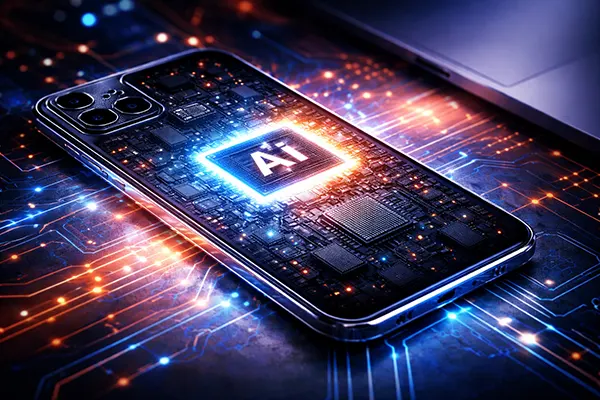
Energy efficiency has also improved with specialised hardware. Neural Processing Units (NPUs) and AI accelerators integrated into modern chipsets—such as Apple’s Neural Engine or Qualcomm’s Hexagon processors—are designed to execute AI tasks with minimal power consumption. This makes continuous AI features viable without significantly impacting battery life.
Hardware Evolution Behind Local AI Processing
The rapid adoption of on-device intelligence is closely tied to advancements in semiconductor design. Chip manufacturers have prioritised AI-specific architectures, enabling devices to handle complex neural network operations efficiently. These components are no longer optional; they are now standard in flagship and mid-range devices alike.
Memory bandwidth and storage optimisation have also played a critical role. AI models are becoming smaller and more efficient, allowing them to run directly on consumer devices without compromising accuracy. Techniques such as model quantisation and edge optimisation have made it possible to deploy advanced machine learning models locally.
At the same time, operating systems have evolved to support these capabilities. Platforms like iOS, Android, and Windows now include built-in frameworks that allow developers to integrate AI features directly into applications without relying on cloud APIs. This has accelerated adoption across industries, from productivity tools to creative software.
Real-World Applications of On-Device Intelligence
In everyday use, on-device AI is already transforming core features. Voice assistants now process commands locally, reducing response time and improving accuracy in noisy environments. This approach also ensures that sensitive voice data remains on the device rather than being stored remotely.
Photography is another area where local AI has made a visible impact. Modern cameras use real-time image processing for scene recognition, HDR adjustments, and object detection. These operations occur instantly, allowing users to capture high-quality images without relying on post-processing in the cloud.
Security has also benefited significantly. Biometric authentication methods such as facial recognition and fingerprint scanning are processed entirely on-device, reducing the risk of data interception. Secure enclaves and hardware-isolated environments ensure that biometric data never leaves the device.
Productivity and Creative Workflows
On-device AI is increasingly integrated into productivity tools. Features like real-time transcription, smart summarisation, and contextual suggestions now operate locally, making them faster and more reliable. This is particularly useful in professional environments where data confidentiality is critical.
Creative applications have also evolved. Video editing, photo enhancement, and even music generation tools now use local AI models to deliver instant results. This eliminates the need to upload large files to external servers, reducing both processing time and bandwidth usage.
Developers are leveraging these capabilities to create more responsive applications. By reducing reliance on cloud infrastructure, software becomes more resilient and accessible, especially in regions with limited connectivity.
Challenges and Limitations of On-Device AI
Despite its advantages, on-device intelligence still faces technical limitations. Local hardware, while powerful, cannot yet match the computational capacity of large-scale cloud systems. This means that extremely complex models still require hybrid approaches, combining local and cloud processing.
Another challenge is storage and resource management. AI models, even when optimised, consume memory and processing power. Device manufacturers must balance performance with user experience, ensuring that AI features do not interfere with other applications or system stability.
There is also the issue of updates and model training. Unlike cloud-based systems that can be updated instantly, on-device models require firmware or software updates. This can slow down the deployment of improvements and new features.
The Future of Hybrid AI Systems
Looking ahead, the most practical approach appears to be a hybrid model. Devices will handle sensitive and time-critical tasks locally, while more complex computations will still rely on cloud infrastructure. This balance allows users to benefit from both privacy and advanced capabilities.
Advancements in edge computing are expected to further blur the line between local and remote processing. By distributing AI workloads across nearby servers and personal devices, systems can achieve both speed and scalability without compromising data security.
As hardware continues to evolve, the gap between on-device and cloud AI will gradually narrow. By 2026 and beyond, local intelligence is not just a feature—it is becoming a baseline expectation for modern computing devices, reshaping how technology is designed and used. :contentReference[oaicite:0]{index=0}