


Orbital Data Centres: Can Energy-Intensive Computing Move Beyond Earth?
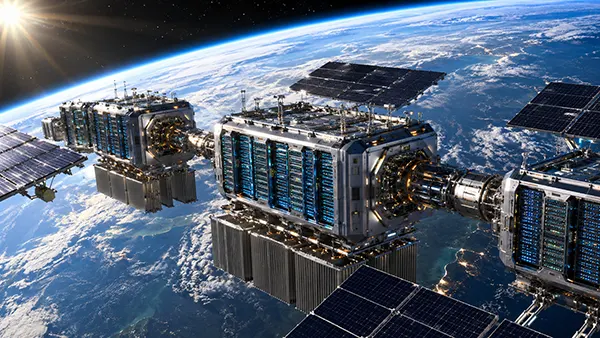
The rapid expansion of artificial intelligence has made electricity, cooling and access to suitable land central concerns for the data-centre industry. As computing requirements increase, researchers and technology companies are considering whether part of this infrastructure could eventually operate beyond Earth. Orbital data centres would use solar energy, process information close to satellites and avoid some of the pressures associated with large facilities on the ground. The idea has progressed beyond theoretical studies: modern graphics processors have already operated in orbit, dedicated computing nodes have been launched, and further experimental missions are scheduled. Even so, moving large-scale computing into space remains an exceptional engineering and economic challenge. Solar power may be readily available, but equipment must still survive radiation, remove heat, communicate with Earth and remain useful without regular physical maintenance. As of 2026, orbital computing is becoming practical for selected space-based tasks, although it is not yet a realistic replacement for conventional data centres.
Why Orbital Data Centres Are Being Considered
Electricity consumption is the main reason the subject has gained serious attention. The International Energy Agency reported in April 2026 that global data-centre electricity use increased by approximately 17% during 2025, while consumption by facilities focused on artificial intelligence rose by around 50%. Its central projection places total data-centre electricity demand at about 485 terawatt-hours in 2025 and approximately 950 terawatt-hours by 2030. AI-focused facilities are expected to account for a growing proportion of that increase because training and operating advanced models requires dense groups of processors working continuously. Improvements in chip efficiency reduce the energy needed for individual tasks, but these gains are being offset by greater use of AI, larger models and more demanding applications such as video generation, automated agents and scientific simulation.
Terrestrial data centres also create concentrated demands on local infrastructure. A large facility may require a new grid connection, substations, backup systems and access to substantial amounts of reliable electricity. In some regions, development is delayed because transformers, transmission equipment and generation capacity cannot be supplied quickly enough. Cooling presents another concern. Not every data centre consumes large quantities of water, as some use closed-loop or air-based systems, but evaporative cooling remains common in suitable climates. Local authorities must therefore balance new computing projects against housing, industry, agriculture and existing water needs. An orbital facility would not require land for server buildings or a connection to a regional electricity network, which makes the concept attractive where suitable ground locations are limited.
The strongest argument for orbital computing is not simply that space receives sunlight. Its main practical advantage is proximity to information already produced beyond Earth. Observation satellites collect high-resolution images, radar measurements, weather data and signals from scientific instruments. Sending every unprocessed file to a ground station can create delays and consume scarce communication capacity. An orbital computing node could examine the information first, remove unusable material, compress important files and transmit only the results that customers need. It might identify a wildfire, oil spill, damaged road, approaching storm or unauthorised vessel without waiting for a complete image archive to reach Earth. Processing data near its source could therefore reduce transmission requirements and shorten the interval between observation and action.
Orbital Computing Has Already Progressed Beyond Theory
One of the most significant demonstrations came from Starcloud-1, a satellite launched in November 2025 with an NVIDIA H100 graphics processor. The H100 was developed for high-performance AI work in terrestrial data centres, making its operation in orbit an important test of whether commercial computing hardware could function in a spacecraft. Starcloud reports that the satellite ran a version of Google Gemini and trained the small nanoGPT language model in December 2025. A single processor does not constitute a large data centre, and the mission does not prove that thousands of connected processors can operate economically in space. It does, however, demonstrate that a current data-centre-class accelerator can perform genuine AI workloads in orbit when supported by suitable power, communications and thermal-control equipment.
Axiom Space has pursued orbital computing through both the International Space Station and independent nodes. Its Data Center Unit One reached the station in 2025 to test cloud computing, artificial intelligence, data fusion and cybersecurity applications without continuous dependence on ground-based systems. Axiom also states that its first two dedicated orbital data-centre nodes successfully entered low-Earth orbit on 11 January 2026. They were launched with part of Kepler Communications’ optical relay network and are intended to exchange information with compatible satellites through high-speed optical links. These initial nodes are modest compared with terrestrial facilities, but their purpose is more practical than symbolic: they are meant to store and process satellite information close to where it is generated.
Further projects show that the field is attracting established technology companies as well as specialist space businesses. Google announced Project Suncatcher in November 2025, describing a possible future network of solar-powered satellites equipped with its Tensor Processing Unit chips. The company plans to launch two experimental satellites with Planet in early 2027 to test hardware, radiation tolerance and communication between spacecraft. In March 2026, NVIDIA announced its Space-1 Vera Rubin Module for orbital AI and stated that it could provide up to 25 times more AI computing performance per processor than the H100 for space-based inference. These announcements should not be mistaken for completed large-scale systems, but they indicate that hardware specifically intended for intensive orbital computing is now under active development.
How a Data Centre Could Operate in Space
A practical orbital data centre would probably consist of multiple independent modules rather than one enormous spacecraft. Each module could contain processors, memory, storage, networking equipment and a cooling circuit. Solar arrays would generate electricity, batteries would provide power during periods without direct sunlight, and radiators would release waste heat. Guidance and propulsion equipment would keep the structure correctly oriented and allow it to avoid tracked objects. A modular design would also make gradual expansion possible. Operators could launch additional computing units when demand increased instead of funding the entire system at the beginning. Faulty sections could be isolated, while newer modules could add more efficient processors without requiring the complete facility to be replaced.
Choosing the right orbit would depend on the service being provided. Low-Earth orbit offers relatively short communication delays and is easier to reach than more distant locations, but satellites there move rapidly around the planet and may pass through darkness several times each day. They also encounter small amounts of atmospheric drag and operate in increasingly crowded regions. Higher orbits could provide different patterns of sunlight and geographical coverage, although they would require more launch energy and make servicing more difficult. A computing node designed to work with Earth-observation satellites would probably remain near its customers in low-Earth orbit. A future facility intended for lunar missions or deep-space research could be positioned elsewhere to reduce its dependence on communication links with Earth.
Software would need to distribute work between orbital and terrestrial equipment. Sending every commercial database into space would be inefficient because moving large quantities of information requires time, energy and expensive communication capacity. It would make more sense to keep frequently used business and consumer data on Earth while assigning specialised tasks to orbital processors. A satellite could send raw imagery to a nearby computing node, receive an analysis and forward a compact report to the ground. More demanding work could be divided, with preliminary processing completed in orbit and deeper analysis performed in terrestrial facilities. This mixed approach would use the main strength of orbital computing — proximity to space-based sensors — without assuming that every stage of a digital service belongs beyond Earth.
Power, Cooling and Communication Remain Difficult
Solar energy is abundant in orbit, but collecting enough of it requires large and durable structures. Panels must generate electricity for processors, storage, networking, pumps, navigation equipment and communication systems. Batteries may also be necessary when the spacecraft passes into Earth’s shadow. Higher computing capacity means larger solar arrays, while any increase in total mass raises the launch cost. Panels gradually lose performance because of radiation and the space environment, so the original design must include additional capacity. The system must also remain pointed correctly: solar arrays need suitable exposure to sunlight, communication equipment must maintain accurate links, and radiators must release heat without receiving excessive solar energy.
Cooling is often misunderstood in discussions about space-based data centres. Space is extremely cold, but a vacuum contains no moving air that can carry heat away from electronic components. Nearly all electricity used by a processor eventually becomes heat, and that heat must first be transferred into a liquid or solid structure. It can then be released as infrared radiation from large external surfaces. The more electricity a data centre consumes, the larger its radiator area generally needs to be. A facility operating at megawatt scale could therefore require extensive cooling structures in addition to its solar panels. Radiators must remain lightweight enough to launch, strong enough to survive deployment and resistant to impacts from small fragments that cannot be tracked from Earth.
Communication capacity determines which workloads are sensible in orbit. Radio links are reliable for many satellite services, but very large computing systems would need much faster connections. Optical communication uses narrowly directed laser beams and can transmit substantial amounts of information between compatible spacecraft. It also requires highly accurate pointing because both the sender and receiver are moving at orbital speeds. Communication with the ground can be interrupted by clouds, atmospheric conditions or the limited visibility of individual stations. A wider network of ground stations and relay satellites can reduce these interruptions, but it adds cost and complexity. Orbital computing is therefore most efficient when a large input can be converted into a much smaller, useful result before transmission.

The Economic and Environmental Case for Computing in Orbit
Launch cost is one of the largest barriers. Every processor must be accompanied by protective structures, solar arrays, radiators, communication equipment and propulsion or guidance systems. The cost of the computing hardware may represent only part of the total mission budget. Reusable rockets have made access to low-Earth orbit less expensive, but a substantial data centre would still require repeated launches and possibly assembly after deployment. Terrestrial operators can deliver new servers by road, replace faulty parts quickly and upgrade equipment whenever a more efficient generation becomes available. Orbital operators would need to plan replacement missions months or years in advance, and an expensive spacecraft could become commercially outdated before the end of its mechanical life.
Environmental benefits are possible, but they cannot be assumed from solar power alone. An orbital facility would not require electricity from a local grid and could avoid the direct consumption of freshwater for evaporative cooling. It would also use less terrestrial land. However, a credible comparison must include rocket production, fuel, launch emissions, ground stations, replacement flights and the manufacture of large orbital structures. The European ASCEND feasibility study, published in 2024 and funded through Horizon Europe, found that space-based data centres could contribute to lower emissions only under demanding conditions. Its assessment indicated that a launch vehicle with approximately ten times lower life-cycle emissions would be required to produce a substantial carbon advantage over comparable terrestrial facilities.
The commercial case is strongest when orbital computing provides a service that cannot be delivered equally well from Earth. Rapid analysis of satellite imagery, autonomous spacecraft operation, space-weather monitoring, secure storage for missions and support for lunar exploration are credible examples. Selling ordinary computing capacity to ground-based customers is less convincing because operators would have to transmit large volumes of information in both directions while paying for launch and specialised equipment. Terrestrial facilities also continue to improve through more efficient processors, renewable electricity, liquid cooling and better use of existing grid capacity. Orbital systems will therefore have to compete with a moving target rather than with today’s data centres frozen in time.
What Is Realistic Between 2026 and 2035?
For the remainder of the 2020s, development is likely to focus on relatively small nodes that perform clearly defined tasks. Current missions are establishing whether commercial processors, solid-state storage and optical communication equipment can operate reliably for extended periods in orbit. Google’s planned 2027 experiment should provide further evidence about radiation effects and links between computing satellites. Axiom Space intends to expand the number and capacity of its nodes, while Starcloud is working towards larger systems after its H100 demonstration. These projects may begin serving observation, research, communications and government customers, but they will remain far smaller than the largest facilities built on Earth.
Larger orbital clusters could become possible during the early 2030s if several conditions improve at the same time. Launch prices would need to decline, spacecraft would need longer working lives, optical networks would require broader coverage, and automated servicing would have to become dependable. Thermal systems must also show that they can remove heat from dense groups of processors without creating structures too large or heavy to be economical. Modular construction offers a plausible route because individual units could be added, replaced or moved without risking the entire investment. Even under favourable conditions, the first larger systems are likely to serve space-related customers rather than compete directly for routine office software, streaming, online retail or consumer AI requests.
Orbital data centres should therefore be viewed as a new category of space infrastructure, not as an immediate solution to every energy problem created by artificial intelligence. They can process information close to satellites, reduce unnecessary transmissions and support missions that must operate with limited contact with Earth. Their ability to relieve terrestrial electricity and water pressures will depend on launch emissions, equipment lifetime and the actual scale achieved. By 2035, orbital computing may become a valuable part of satellite networks and scientific operations, while conventional data centres continue to handle most global digital activity. The decisive measure will not be whether powerful processors can be launched, as that has already been demonstrated, but whether complete systems can deliver useful work reliably and economically for many years.